1. Overview
Under EU and UK law, individuals have the right to know what personal data an organisation processes about them and how it is used. You can exercise this right for review and update by submitting the form below.
The rules for DSARs are outlined in the GDPR (General Data Protection Regulation), and these have been carried over into UK data protection law with only a few exemptions, which are detailed in Section 45(4) of the DPA (Data Protection Act) 2018.
DSARs as a concept were not created with the GDPR, but the legislation standardised several processes that make it easier for individuals to submit requests and place a greater burden on organisations to complete them.
2. What Are Data Subject Access Requests?
DSARs are the result of the GDPR’s right of access — one of eight data subject rights enshrined in the Regulation.
The right to be informed (Articles 13 & 14)
We need to tell our customers:
- What personal data we’re collecting from them
- How we are using it (or will be using it)
- How long we’re keeping it for; and
- Various other information.
Most data controllers choose to communicate this information via a privacy notice.
The right of access (Article 15)
Data subjects may request a copy of the personal data we are processing (on that data subject), as well as information we must also share under Articles 13 and 14 (the right to be informed).
This includes:
- The purpose(s) of processing;
- The categories of personal data;
- The recipients of the personal data;
- Whether automated decision-making is taking place, its significance, and envisaged consequences for the data subject; and
- Whether we’re transferring the data internationally, and if so, what safeguards are in place.
We must also inform data subjects of their other GDPR rights, including the right to lodge a complaint with the ICO (Information Commissioner’s Office).
When someone exercises this right, we must respond within one month.
The right to rectification (Article 16)
One of the key GDPR principles (Article 5(1)(d)) is ‘accuracy’. If exercised — meaning that a data subject alerts us to incorrect personal data on them — we (the data controller) must correct it.
The right to rectification also means that if a data subject points out that, within the purposes of data processing, the data on them is incomplete, we must complete it.
When someone exercises this right, we have one month to make the corrections and respond to the data subject.
When an individual submits a data subject access request (or SAR), AB PLUS must provide them with a copy of any relevant information about them.
The right to erasure (Article 17)
The right to erasure is also known as the ‘right to be forgotten’. It obliges us to erase someone’s data if they ask, where any of the following applies:
- The processing was unlawful to begin with.
- The data subject has withdrawn their consent.
- We need to destroy the data to comply with a legal obligation.
- We no longer need the personal data for the purpose(s) for which we collected it.
- We were collecting the data to offer information society services directly to a child.
- The data subject can legitimately object to the processing.
This right isn’t absolute. If we receive a request, we must respond within one month.
The right to restrict processing (Article 18)
If a data subject exercises this right, we may store their data but not process it. Someone may exercise this right because:
- They’re contesting the accuracy of the personal data;
- The processing is unlawful, but the subject doesn’t want their data destroyed;
- They’re challenging whether our legitimate grounds for processing override their interests; or
- We don’t need the personal data anymore, but the subject needs it for a legal claim.
If exercised, we must respond within one month.
The right to data portability (Article 20)
This right allows people to obtain their data from us in a “structured, commonly used and machine-readable format”, so they can easily reuse their data for other purposes.
Data subjects can only exercise this right if:
- They provided their data under the lawful basis of consent; and
- Where the processing is carried out by “automated means”.
The right to object (Article 21)
“The data subject shall have the right to object, on grounds relating to his or her particular situation, at any time to processing of personal data concerning him or her which is based on points (e) or (f) of Article 6(1), including profiling based on those provisions. The controller shall no longer process the personal data unless the controller demonstrates compelling legitimate grounds for the processing which override the interests, rights and freedoms of the data subject or for the establishment, exercise or defence of legal claims.”
Article 21(2) also specifies that data subjects can object to their data being used for direct marketing purposes “at any time” — meaning that this is an absolute right.
Whether or not we comply, we must inform the data subject of our decision within one month.
Rights related to automated decision-making, including profiling (Article 22)
People have the right not to be subject to any automated decision-making with potentially legal or similarly significant consequences for them, unless:
- We need to conduct the processing to enter into a contract with the data subject;
- We’re required or authorised by law to conduct the processing; or
- The data subject has explicitly consented to the processing.
Where we proceed with the processing, we must:
- Inform the data subject about the processing;
- Enable them to easily request human intervention or challenge a decision; and
- Regularly review our systems to make sure they’re working as intended.
3. What Is Included in a DSAR?
A request might refer to specific personal details or processes. In these cases, we only need to provide relevant information.
However, a customer may ask to see a complete list of the personal data that AB PLUS stores on their profile. Our first tasks are to determine what information is considered personal data under the GDPR definition, and whether it’s part of what was requested.
This information must be provided alongside other supplementary material, such as the relevant details from our privacy notice.
4. Can Information Be Redacted?
Although the GDPR promotes openness, AB PLUS can and should redact anything that’s not within the scope of the DSAR. For example, documents that include the individual’s personal data alongside other people’s personal details — we are required to redact all personal data that isn’t about the person making the request.
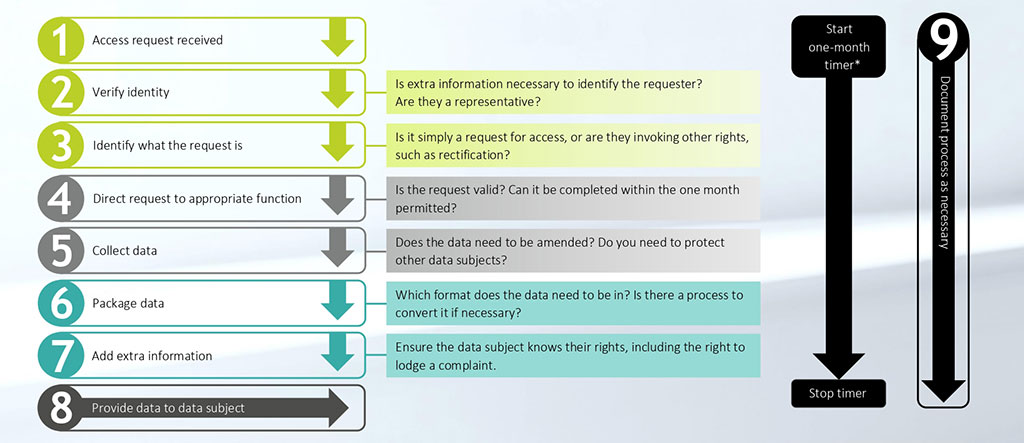
5. DSAR Flowchart
We follow the steps below when responding to a data subject access request:
6. Do Customers Need to Give a Reason?
Customers don’t need to state why they are submitting a DSAR. The only questions we may ask concern verifying the individual’s identity or helping locate the requested information.
7. Does a Request Have to Be in Writing?
You can submit the form below, or email info@ab-money.co.uk, or call 0203 355 9660 while speaking with a member of staff.
Individuals aren’t required to use the technical term ‘DSAR’ or ‘data subject access request’ for a request to be valid.
8. Can You Submit a DSAR on Behalf of Someone Else?
Yes, you can authorise someone else to make a request on their behalf. This is most likely to happen when:
- Someone with parental responsibility asks for information about a child;
- A court-appointed individual is managing someone else’s affairs;
- A solicitor is acting on their client’s instructions; and
- The data subject requests help from a relative or friend.
We are entitled to request supporting evidence, such as written authorisation from the data subject or a power of attorney.
9. How Long Does AB PLUS Have to Respond?
DSARs must be fulfilled “without undue delay”, and at the latest within one month of receipt.
Where requests are complex or numerous, we are permitted to extend the deadline to three months. However, we must still respond to the request within a month and explain why the extension is necessary.
10. Who Is Responsible for Responding?
Our support team will generally be responsible for fulfilling a DSAR. We oversee the process and ensure it is completed in line with the GDPR’s requirements.
11. Is There a Fee?
Under GDPR, organisations can no longer charge a fee for fulfilling a DSAR in most instances. AB PLUS does not charge a fee for fulfilling a DSAR for our customers.
12. What’s the Difference Between a DSAR and an FOI Request?
DSARs grant EU/UK residents access to copies of their personal data. Freedom of Information (FOI) requests are specific to the UK and relate to recorded information held in the public sector (e.g. government departments, local councils, regulators). Personal data is not covered by the FOI Act.
13. The Process for Handling a DSAR
Verify the identity
One of the first steps is to verify the identity of the requester so that we can determine whether we have all the information we need to fulfil the request.
Clarify what the request is
Find out more about the request itself. Is it merely a request for access, or are they invoking other rights, such as rectification of the personal data being held?
Is the request valid?
Establish whether the request is valid and if it can be completed within the one-month period. If not, we can take further steps to request an extension.
Inspect the data
Once we start collecting the data, check whether the data needs to be amended and if we need to protect the personal information of any other data subjects.
Choose the format
Once all the data has been collected, determine the most appropriate format in which to provide the information.
Add extra information
Before sending the information, ensure the data subjects know their rights, including the right to lodge a complaint.
14. How to Ensure DSAR Success
Staff training
Data subjects can theoretically submit a DSAR whenever they communicate with a member of staff. We ensure that all relevant employees can recognise a request and know how to respond.
DSAR responsibilities
We appoint someone or a team of people to take responsibility for responding to DSARs who is familiar with the GDPR’s compliance requirements. We make sure multiple employees know how to complete a request so they can fill in during holidays or other absences.
Contact Us
To exercise any of the above rights, please contact us:
- Email: info@ab-money.co.uk
- Phone: +44 (0) 203 355 9660
- Post: A&B General (UK) Limited, 18 Victoria Parade, London SE10 9FR
We will respond within one month of receipt. In complex cases we may extend this by a further two months, and we will notify you within the first month.
For independent advice, contact the Information Commissioner’s Office (ICO):
- Website: ico.org.uk
- Helpline: 0303 123 1113